soft_body_anatomy
A rigid-body is a single moving frame: the position and the velocity of any of its points follow from one translation and one rotation. This is precisely what a deformable body can't be, because its parts must be able to move (somewhat) independently of each other. Instead, a soft-body is made of particles, aka. mass points, i.e., points without any orientation, each having 2 degrees of freedom in 2D and 3 in 3D. The more particles a body is made of, the more detailed its deformations can be, and the more expensive it is to simulate.
The particles are kept together by a lattice made of up to three kinds of elements:
- The particles are the only mandatory element, i.e., the positions the
SoftBodyBuilderSoftBodyBuilder(wrapped by theSoftBodycomponent)SoftBodyDescR3SoftBodyDescSoftBodyBuilder - The edges (
edgessetEdgesedgesedgesbend_edgessetBendEdgesbendEdgesbend_edgesdihedralssetDihedralsdihedralsdihedrals - The cells (
cellssetCellscellscells
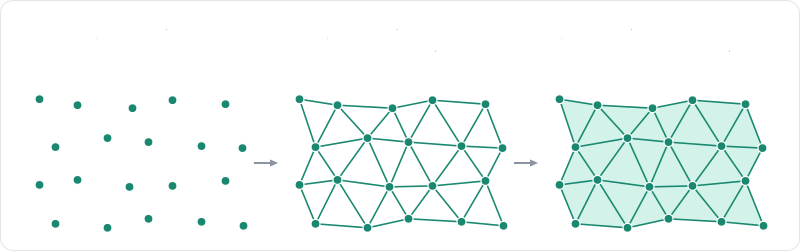
Two more concepts describe how the body interacts with the rest of the world. The surface
(surfacesetSurfacesurfacesurfacewiresetWirewire, 3DwireskinsetSkinskinVertices and skinIndicesskin
Every element can be given manually to the soft-body (E, 2) for the edges and (C, 4) for the cells), or as sequences of tuples, and replace the elements generated by the constructor (see also add_edges).